What Parents Should Know About Grade 3 Math (Common Core)
Introduction
Grade 3 is a major transition year in US elementary math. Until Grade 2, children mostly work with counting, basic place value, and simple addition and subtraction. In Grade 3, math becomes more structured and concept-heavy. This is the year when students move from “doing math” to understanding how math works.
Grade 3 places strong emphasis on number sense, reasoning, and explanation, not just correct answers. Teachers expect children to explain why a method works, represent their thinking using models or drawings, and solve real-world word problems using multiple steps. This shift often catches parents off guard, especially if they learned math in a more procedural way.
One of the biggest changes in Grade 3 is the introduction of multiplication and division as core topics, not shortcuts or memorized facts. Students learn these ideas through equal groups, arrays, number lines, and word problems before formal fluency is expected. At the same time, addition and subtraction expand to larger numbers, requiring stronger place-value understanding and regrouping skills.
Another important focus is fractions, but not in the way many parents remember. Grade 3 does not involve fraction arithmetic. Instead, children learn what fractions mean: equal parts, unit fractions, and fractions on number lines. This conceptual foundation is critical for success in later grades.
Measurement, data interpretation, and basic geometry also play a meaningful role, with students learning to reason about time, area, perimeter, shapes, and graphs in practical contexts.
If Grade 3 math feels more demanding than earlier grades, that’s intentional. The goal is not speed or rote learning, but deep understanding that supports long-term math confidence. With the right explanations and visual support, most children adjust well—and often begin to see math as something logical rather than mysterious.
Number Sense and Place Value (Building Understanding Beyond Hundreds)
In Grade 3, number sense goes well beyond simply reading and writing numbers. Under Common Core, students should understand how numbers are built, how each digit’s position affects its value, and how this structure helps them reason while solving problems.
Children work confidently with numbers up to 1,000. This includes reading numbers in standard form, word form, and expanded form, and understanding that the same digit can represent very different values depending on its place. For example, the 5 in 508 does not mean the same thing as the 5 in 85. Grade 3 students should be able to explain this clearly, not just use it mechanically.
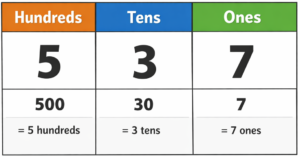
A major emphasis is on composing and decomposing numbers. Students break numbers apart into hundreds, tens, and ones, and recombine them in flexible ways. This skill is essential later for addition, subtraction, estimation, and mental math. Parents often notice that the curriculum encourages kids to “take numbers apart” even when a direct calculation might seem faster.
Another key expectation is comparing and ordering numbers using place-value reasoning. Instead of relying on guesswork or visual size, students learn to compare digits starting from the highest place value and justify their comparisons using words like “greater than,” “less than,” and “equal to.”
Grade 3 also introduces rounding to the nearest ten or hundred. The goal is not memorization of rules, but understanding why rounding makes sense and how it helps estimate answers. Students are often asked whether an estimated answer is reasonable before or after solving a problem exactly.
Importantly, number sense is not treated as a standalone topic. It is continuously used while solving word problems, explaining strategies, and checking answers. A child with strong place-value understanding finds Grade 3 math far less stressful, because larger numbers no longer feel intimidating. Instead, they feel predictable.
Parents can support this at home by encouraging children to explain their thinking out loud, especially when comparing numbers or estimating answers. In Grade 3, how a child thinks matters just as much as the final answer.
Addition and Subtraction Within 1,000 (Accuracy, Reasoning, and Flexibility)
In Grade 3, addition and subtraction move beyond simple calculations and become exercises in reasoning and place-value understanding. Students need to add and subtract numbers within 1,000, accurately and efficiently, while also being able to explain the strategy they used.
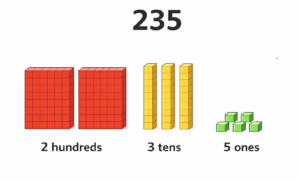
A key expectation at this level is fluency with regrouping (often called carrying and borrowing). However, Common Core places less emphasis on memorizing one fixed algorithm and more emphasis on understanding why regrouping works. Students may solve the same problem in different ways – using expanded form, breaking numbers apart, or applying the standard written method, and are encouraged to explain their thinking.
Grade 3 students frequently work with word problems that involve one or two steps. These problems require children to decide whether to add or subtract, identify relevant information, and check whether their final answer makes sense. This is where many students struggle, not because of weak calculation skills, but because of difficulty translating words into math.
Another important focus is mental math and estimation. Students estimate sums and differences before or after solving, and to judge whether an answer is reasonable. For example, before subtracting 498 from 723, a student might reason that the answer should be a little more than 200. This habit strengthens number sense and reduces careless errors.
Common Core also encourages students to use multiple representations, such as number lines, place-value drawings, and base-ten models, especially when explaining solutions. Written work is no longer just about getting the right answer. It’s about showing thinking clearly.
For parents, it can feel confusing when a child uses a method different from the one they were taught. This flexibility is intentional. When children understand addition and subtraction in more than one way, they are better prepared for larger numbers, mental math, and later algebraic thinking.
Multiplication and Division (Understanding Equal Groups, Arrays, and Sharing)
Grade 3 is the year when multiplication and division become central ideas, not just memorized facts. Common Core expects students to understand what multiplication and division mean before focusing on speed or recall.
Grade 3 introduces multiplication through equal groups, arrays, and repeated addition. For example, instead of being told that 4 × 3 equals 12, students learn to see it as four groups of three objects, or as an array with 4 rows and 3 columns. This visual and conceptual approach helps children understand why multiplication works, not just how to calculate it.
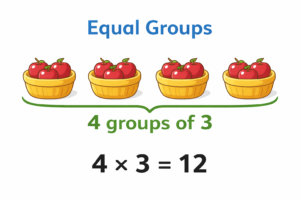
Teachers teach division alongside multiplication as its inverse operation. Students learn division through sharing and grouping. For instance, dividing 12 objects equally among 4 groups, or finding how many groups of 3 fit into 12. At this stage, division is about reasoning and modeling, not long-division procedures.
A major Common Core expectation is that students solve word problems involving multiplication and division within 100. These problems often require careful reading and interpretation, such as deciding whether a situation calls for equal sharing or equal grouping. This is where many students struggle, even if they know their facts, because the math is embedded in language.
Grade 3 also introduces the relationship between multiplication and division using fact families. Understanding that 3 × 4, 4 × 3, 12 ÷ 3, and 12 ÷ 4 are all connected builds flexibility and confidence.
Students gradually develop fluency. By the end of Grade 3, students are expected to be fluent with multiplication and division facts within 100, but Common Core strongly emphasizes that fluency should come from understanding, not rote memorization alone.
For parents, this explains why children may draw pictures, make arrays, or act out problems even when a faster method seems obvious. These models are not shortcuts, they are building blocks for long-term success in higher math.
Fractions (Understanding Parts of a Whole and the Number Line)
Grade 3 introduces fractions as numbers with meaning, not as symbols to manipulate. Common Core focuses entirely on fraction understanding, not fraction operations. This foundation is critical, and gaps here often cause difficulties in later grades.
Students begin by learning that a fraction represents equal parts of a whole. Teachers place strong emphasis on the word equal. Children must understand that fractions only make sense when a whole is divided into parts of the same size. For example, cutting a shape into four unequal pieces does not create fourths, even though there are four pieces.
Grade 3 students work extensively with unit fractions, such as one-half, one-third, or one-fourth. A unit fraction represents one part of a whole that has been divided into a certain number of equal parts. From there, students build non-unit fractions by combining unit fractions, such as understanding that three-fourths means three pieces of size one-fourth.
Another major focus is representing fractions in multiple ways. Students shade parts of shapes, use fraction strips, and place fractions on number lines. The number line is especially important because it helps children understand that fractions are numbers with specific positions and sizes, not just parts of pictures.
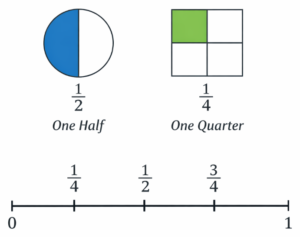
Students also learn to compare fractions with the same denominator or the same numerator by reasoning about their size. Instead of cross-multiplying or using rules, children are encouraged to think visually and conceptually. For example, they might reason that one-fourth is smaller than one-half because the whole is divided into more pieces.
Throughout this topic, teachers emphasize explanation. Students are often asked to explain why a fraction is larger or smaller, or how they know two fractions are equal. This focus on reasoning prepares them for fraction operations in later grades.
For parents, it’s important to know that Grade 3 fractions are about building intuition, not speed or formulas. When children truly understand fractions at this stage, Grades 4 and 5 become far smoother.
Measurement and Data (Time, Length, Area, and Interpreting Graphs)
Grade 3 expands measurement from simple comparisons into reasoning with standard units and data. Under Common Core, students are expected not just to measure, but to understand what measurement tells us and how to use it to solve real-world problems.
One major focus is time. Students learn to tell time to the nearest minute and solve problems involving elapsed time. This includes determining how long an activity lasts or finding the time when an activity ends. Elapsed time is often challenging because it requires both clock-reading skills and logical reasoning, especially when time crosses the hour.
Students also work with length and mass using standard units. They measure objects using inches, feet, centimeters, and meters, and compare measurements using addition and subtraction. Importantly, Common Core emphasizes choosing appropriate units and tools, not just performing measurements mechanically.
Grade 3 introduces area as a new concept. Students learn that area measures the amount of surface a shape covers, and they find area by counting square units. Rather than memorizing formulas, children build rectangles using unit squares and reason about rows and columns – an approach that directly supports later multiplication concepts.
In data and graphing, students collect, represent, and interpret data using picture graphs and bar graphs. They answer questions such as “How many more?” or “How many fewer?” based on graph information. This helps children connect numbers to real situations and strengthens comparison skills.
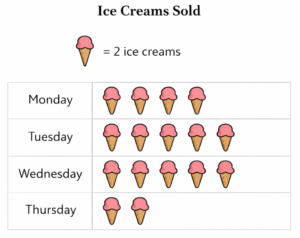
Word problems play a central role in this section. Students often combine measurement with addition or subtraction, reinforcing earlier arithmetic skills while applying them in meaningful contexts.
For parents, this is a stage where hands-on activities – measuring household objects, reading clocks, or discussing graphs in books and media – can greatly reinforce classroom learning.
Geometry (Shapes, Attributes, and Spatial Reasoning)
In Grade 3, geometry focuses on helping students analyze and describe shapes, rather than simply name them. Common Core emphasizes understanding a shape’s attributes, such as sides, angles, and how those parts relate, so children can reason about shapes in a deeper way.
Students work with a variety of 2D shapes, including squares, rectangles, rhombuses, trapezoids, and different types of triangles. Instead of memorizing definitions, children learn to classify shapes based on shared attributes. For example, they may explore how squares and rectangles are similar, and why a square is a special type of rectangle.
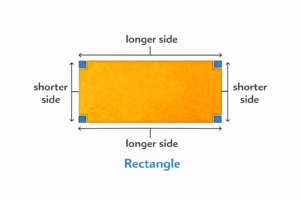
A key idea introduced in Grade 3 is that shapes can belong to more than one category. This can feel counterintuitive to parents. For instance, a shape can be both a quadrilateral and a rectangle at the same time. This flexible thinking helps students move away from rigid labels and toward logical classification.
Students also work with partitioning shapes into equal parts. They divide shapes into halves, thirds, or fourths and describe those parts using fractions. This connects geometry directly to the fraction concepts introduced earlier and reinforces the idea that fractions apply to shapes as well as numbers.
Spatial reasoning is developed through activities that involve drawing shapes, identifying lines of symmetry informally, and reasoning about shape orientation. Students learn that turning or flipping a shape does not change what the shape is, even though it may look different.
For parents, geometry in Grade 3 may seem less calculation-heavy, but it plays a crucial role in building logical thinking and precision in language. Children who can clearly describe why a shape belongs to a category are developing the kind of reasoning that supports algebra and problem-solving later on.
Problem Solving and Mathematical Thinking (How Common Core Ties Everything Together)
The third grade curriculum does not treat problem solving as a separate topic; it is woven into every area of math. Common Core expects students to use what they know about numbers, operations, fractions, measurement, and geometry to make sense of real-world situations.
Students regularly solve one or two-step word problems that require deciding what operation to use, choosing a strategy, and explaining their reasoning. They may be asked to draw a diagram, or describe their thinking in words. This emphasis helps children move away from guesswork and toward logical, step-by-step reasoning.
A key expectation at this level is that students justify their answers. It is no longer enough to write a number. Children are encouraged to explain how they know an answer is correct, whether by using place-value reasoning, equal groups, number lines, or visual models. This habit builds clarity and confidence.
Grade 3 also introduces the idea of checking for reasonableness. Students estimate before solving, or review their answers afterward to see if the result makes sense. This skill reduces careless errors and encourages independent thinking.
Throughout the year, teachers expose students to multiple strategies for the same problem. One child might solve a problem using a drawing, another using an equation, and a third using mental math. Common Core values this flexibility, as it shows true understanding rather than memorization.
For parents, this explains why homework may look unfamiliar or more open-ended than expected. The goal is to help children become thinkers who can adapt, not just calculators who follow steps.
When students build strong problem-solving habits in Grade 3, they are far better prepared for the increasing complexity of math in later grades.
Conclusion: How Parents Can Support Grade 3 Math Success
Grade 3 is a foundational year in US math education. The Common Core standards move children beyond memorizing steps and toward understanding how math works. While this shift can feel challenging at first, it lays the groundwork for confidence and success in later grades.
The most important support parents can offer is patience with thinking, not speed. When children draw models, explain their reasoning, or solve problems in unexpected ways, they are doing exactly what Grade 3 math is meant to encourage. These habits matter far more than finishing quickly.
At home, parents can help by asking simple questions such as:
-
“How did you figure that out?”
-
“Does your answer make sense?”
-
“Can you show it in a picture or another way?”
Every topic in Grade 3 – place value, addition and subtraction, multiplication and division, fractions, measurement, geometry, and problem solving – is connected. When children see these connections, math becomes less intimidating and more logical.
With consistent practice, visual support, and encouragement to explain ideas clearly, most students adjust well to the increased expectations of Grade 3. More importantly, they begin to see math as something they understand, not just something they do.