What Parents Should Know About Grade 4 Math (Common Core)
Introduction
Fourth grade is the year when elementary math begins to feel more serious and more structured. Students are no longer simply learning new ideas. Instead, they are expected to apply previous skills with greater accuracy, independence, and depth. The foundations built in earlier grades, especially in multiplication, division, and fractions, are now extended into more complex territory.
The Common Core standards at this level place a strong emphasis on multi-digit operations, fraction equivalence and operations, expanded place value understanding, and deeper problem-solving. Children work with larger numbers, more formal written methods, and multi-step word problems that require careful interpretation.
One noticeable shift is the expectation of fluency alongside reasoning. Students must calculate accurately, but they must also explain their thinking clearly. They are encouraged to show models when helpful, justify comparisons, and check whether their answers are reasonable. Math is no longer about following steps; it is about understanding structure.
Place value extends into the millions, and decimals are introduced. Multiplication and division move beyond basic facts into multi-digit procedures. Fractions become more sophisticated, involving equivalence, comparison, and operations with like denominators. Measurement includes unit conversions and angle concepts, while geometry focuses on classifying shapes and understanding symmetry.
Because many of these topics connect to one another, fourth grade can feel demanding at times. However, this year plays a crucial role in preparing students for middle school math. With steady practice and encouragement to think logically, most students gain both confidence and fluency.
Number and Place Value (Whole Numbers to One Million and Decimals)
Fourth grade marks a major expansion in place value understanding. Students move beyond the thousands and begin working confidently with numbers up to one million. They read, write, compare, and round multi-digit numbers while deepening their understanding of the base-ten system.
At this level, children learn that each place represents ten times the value of the place to its right. Recognizing that a digit in the thousands place is ten times the value of the same digit in the hundreds place helps students see the multiplicative structure of our number system. This insight supports later algebraic reasoning and makes large numbers easier to manage.
Students learn to write numbers in standard, word, and expanded forms. For example, 582,341 can be broken into place values and rewritten in multiple ways. This flexibility strengthens number sense and prepares students for more advanced operations.
Comparison becomes more precise. Rather than relying on intuition, students compare digits starting with the greatest place value and explain which digit determines the result. Rounding also expands to any given place value. More importantly, students use rounding to estimate and check whether their answers are reasonable.
Decimals to the tenths and hundredths places are introduced as extensions of place value. Students learn that decimals represent fractional parts and follow the same structure as whole numbers in the opposite direction. Connecting decimals such as 0.8 and 0.75 to fractions with denominators of 10 and 100 helps prevent confusion.
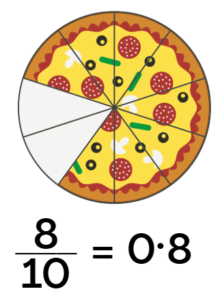
Strong place-value understanding at this stage builds confidence and supports all future work with large numbers and decimal computation.
Multi-Digit Multiplication and Division (Fluency and Conceptual Understanding)
In fourth grade, multiplication and division extend into structured multi-digit computation. Students apply their understanding of place value and basic facts to larger numbers while maintaining clarity about why the procedures work.
Multiplication expands to include up to four-digit numbers multiplied by a one-digit number and two two-digit numbers multiplied together. Before relying on the standard algorithm, students often use area models and partial products. For example, when multiplying 34 by 27, they break the numbers into tens and ones and calculate partial products such as 30 × 20 and 4 × 7 before combining the results. This approach reinforces place value and shows how each digit contributes to the final product.
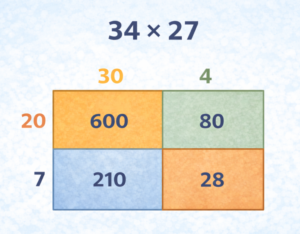
As fluency develops, students transition to the standard multiplication algorithm. Even then, they should know that regrouping is a reflection of place value, not a trick to memorize.
Division becomes more systematic as well. Students divide up to four-digit numbers by one-digit divisors using place-value reasoning. Instead of following steps mechanically, they consider how many groups of the divisor fit within each place value.
Remainders receive careful attention. In some contexts, a remainder represents leftover items; in others, it requires rounding or interpretation. Multi-step word problems often combine operations, requiring students to choose appropriate strategies and estimate to check reasonableness.
This stage strengthens both computational fluency and conceptual understanding, forming an essential bridge to later mathematical reasoning.
Fractions (Equivalence, Comparison, and Operations)
Fractions play a central role in fourth grade. Students move beyond viewing fractions simply as parts of a whole and begin working with equivalence, comparison, and basic operations in a more structured way. Because fraction understanding supports later algebra and proportional reasoning, this unit is especially important.
Students explore equivalent fractions systematically. They learn that multiplying or dividing both the numerator and denominator by the same number creates a fraction with the same value. Visual models and number lines help them understand why the overall quantity remains unchanged even when the number of equal parts increases.
This foundation allows students to compare fractions with different denominators. They use common denominators, benchmark fractions such as one-half, and place-value reasoning to determine which fraction is larger. Clear explanation is emphasized so that students justify their comparisons rather than rely on guesswork.
Addition and subtraction of fractions with like denominators are formalized. Students recognize that the denominator remains the same because the size of the pieces does not change. Word problems reinforce this reasoning in practical contexts.
Mixed numbers and improper fractions are introduced more formally. Students convert between the two forms and understand that both represent the same quantity. They also multiply a fraction by a whole number, interpreting it as repeated addition or scaling.
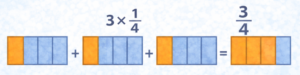
Throughout this unit, fractions are treated as numbers that can be placed on a number line, decomposed, and recomposed. Strong conceptual understanding at this stage reduces future difficulty and builds lasting confidence.
Measurement and Data (Conversions, Area, Angles, and Line Plots)
In fourth grade, measurement becomes more analytical and closely connected to arithmetic. Students use measurement not just to describe objects but to solve multi-step problems and reason about quantities.
Unit conversion is a key development. Students convert within the same measurement system, such as inches to feet or minutes to hours, using multiplication and division rather than memorizing isolated facts. Understanding that one foot equals twelve inches allows them to decide whether to multiply or divide based on context. These conversions often appear in word problems that require careful reading and organized thinking.
Area and perimeter receive deeper attention. Kids formalize the relationship between area and multiplication, recognizing that the area of a rectangle equals length multiplied by width. Rather than applying a formula blindly, they connect area to arrays and repeated addition. Perimeter problems also become more complex, especially when side lengths are unknown and must be determined using reasoning.
Fourth grade introduces angle measurement as a new concept. Students learn that an angle represents a turn and that a full circle measures 360 degrees. Using protractors, they measure and classify angles and solve problems involving unknown angle measures.
Data representation expands through line plots, sometimes including fractional measurements. Students interpret data and answer questions based on the information shown.
Throughout this unit, measurement connects directly to multiplication, division, fractions, and logical reasoning, helping students see math as an integrated system.
Geometry (Classifying Shapes and Understanding Symmetry)
Geometry in fourth grade shifts from simple recognition of shapes to deeper analysis and classification. Students begin to organize shapes based on shared properties rather than viewing each shape as completely separate. This approach strengthens logical thinking and prepares them for more advanced geometry in later grades.
A major focus is identifying and reasoning about parallel and perpendicular lines. Students learn to recognize these relationships within shapes and in real-world contexts. Understanding how lines relate to one another helps children describe shapes more precisely and supports later work in coordinate geometry.
Angle classification also becomes more structured. Students identify and compare acute, right, and obtuse angles, using both visual reasoning and measurement. Rather than memorizing definitions alone, they analyze how angle size affects the overall shape.
Another important development is hierarchical classification. Students explore how some shapes fit into broader categories. For example, they understand that a square is also a rectangle because it has four right angles, and that both squares and rectangles are types of quadrilaterals. This layered classification builds flexible thinking and helps students see connections rather than isolated facts.
Symmetry receives more focused attention as well. Students identify lines of symmetry in two-dimensional figures and explain why a line does or does not create two mirror-image halves. Recognizing symmetry strengthens spatial reasoning and visual analysis.

Geometry at this level emphasizes reasoning and explanation. Students must justify why a shape belongs to a particular category or why it does not. This expectation reinforces precision in mathematical language and clarity in thinking.
Because geometry connects to area, angles, fractions, and measurement, students begin to see how mathematical ideas support one another. When children can describe shapes confidently and reason about their properties, they build a strong foundation for middle school mathematics.
Problem Solving and Mathematical Thinking (How Common Core Ties Everything Together)
Throughout fourth grade, problem solving is not treated as a separate topic. Instead, it runs through every domain – place value, operations, fractions, measurement, and geometry. Students are expected to apply what they know in situations that require planning, reasoning, and careful interpretation.
Word problems at this level often involve multiple steps. A student may need to multiply to find a total, convert units, and then subtract to compare amounts. These layered problems require organization and persistence. Rather than immediately choosing an operation, students are encouraged to think through what the question is asking and decide on a strategy.
Clear explanation becomes increasingly important. Students are expected to show equations that represent a situation and explain how those equations connect to the problem. They may draw diagrams, use models, or break problems into smaller parts. This emphasis on communication strengthens understanding and prevents procedural errors.
Estimation continues to play a central role. Before solving a multi-digit multiplication problem, for example, students are encouraged to round the numbers to get a rough idea of the expected result. After solving, they check whether the answer makes sense in context. This habit builds independence and reduces careless mistakes.
Precision in language is also emphasized. Students learn to use mathematical vocabulary accurately when describing their thinking. Terms such as factor, multiple, product, quotient, equivalent fraction, perpendicular, and parallel are used purposefully rather than casually.
Perhaps most importantly, fourth grade encourages persistence. Students are expected to approach unfamiliar problems with confidence, try strategies, revise their thinking if necessary, and justify their conclusions. This mindset prepares them for increasingly abstract mathematics in later grades.
Conclusion: How Parents Can Support Grade 4 Math Success
Fourth grade represents an important stage in mathematical growth. The expectations increase, the numbers get larger, and the problems become more layered. At the same time, students gain the opportunity to build real independence and confidence in their thinking.
One of the most effective ways parents can help is by encouraging explanation rather than speed. When a child solves a problem, asking questions such as “How did you know?” or “Can you show me another way to get there?” reinforces reasoning skills. This approach aligns closely with the Common Core emphasis on understanding structure rather than memorizing steps.
Consistent practice with multi-digit operations, fractions, and word problems also makes a meaningful difference. Short, regular practice sessions are often more effective than long, occasional ones. Encouraging estimation before solving and checking answers afterward helps children develop independence and reduces simple errors.
When students struggle, it is often not because they lack ability, but because they are adjusting to more complex reasoning. Patience and steady support can help them navigate this transition successfully.
By the end of fourth grade, students who feel comfortable working with larger numbers, explaining their reasoning, and connecting ideas across topics are well prepared for middle school mathematics. With encouragement and thoughtful practice, most children develop both fluency and confidence during this important year.