What Your Child Is Expected to Know in Year 4 Maths (Australia)
Introduction
Year 4 is the year when maths becomes noticeably more demanding for many students. The jump is not always obvious from the topics listed, but the expectations around reasoning, accuracy, and independence increase sharply.
In Year 3, students are still building foundations. In Year 4, teachers expect those foundations to be in place. Children are asked to work with larger numbers, handle more steps within a single problem, and explain their thinking more clearly and consistently.
This is also the stage where gaps that were manageable in earlier years begin to surface more frequently. A child may still “know the basics” but struggle to keep up when problems involve multiple concepts at once, such as combining number skills with measurement, data, or logical reasoning.
Understanding what Year 4 maths really involves helps parents recognise whether their child is adjusting well to these higher expectations or whether additional support may be needed to prevent small gaps from becoming ongoing difficulties.
Representing Numbers (Place Value, Ordering & Rounding)
In Year 4, students are expected to work confidently with four-digit numbers and to demonstrate a clear understanding of place value beyond simple recognition.
Children must read, write, compare, and order numbers up to at least 10,000, explaining their reasoning rather than guessing based on the first digit. They are also expected to decompose numbers in different ways, showing flexibility in how numbers can be represented.
A major new expectation at this stage is rounding. Students learn to round numbers to the nearest ten, hundred, or thousand and to understand why a number rounds up or down. This requires a secure grasp of place value and can be confusing for children who rely on rules without understanding.
Many Year 4 students struggle when rounding is embedded inside word problems or multi-step questions. Errors often occur not because the child cannot round, but because they lose track of which place value the question is asking about.
Strong number representation skills in Year 4 are essential. Weakness here quickly affects later topics such as estimation, decimals, measurement conversions, and problem-solving involving larger numbers.
Addition & Subtraction (Multi-step Problems and Estimation)
In Year 4, addition and subtraction are no longer treated as isolated calculations. Students are expected to solve multi-step problems where choosing the correct operations is as important as carrying them out accurately.
Children work with larger numbers and are often required to combine addition and subtraction within the same question. Word problems become longer and may include extra information that must be ignored. This increases the cognitive load and exposes weaknesses in reading comprehension and logical sequencing.
Estimation plays a bigger role at this stage. Students are expected to estimate answers before calculating and to judge whether a final answer is reasonable. This relies heavily on place value understanding and rounding, which is why gaps in earlier topics often surface here.
A common difficulty in Year 4 is losing accuracy across multiple steps. A small mistake early in the problem can affect the final answer, even if the child understands the overall method. Some students rush through calculations, while others become overwhelmed by the length of the question and lose confidence.
By the end of Year 4, students are expected to show not just correct answers, but clear working and reasoning, especially when problems are presented in unfamiliar contexts.
Multiplication & Division (Factors, Word Problems, and Reasoning)
In Year 4, multiplication and division become more structured and demanding. Students are expected to work confidently with their times tables while also applying them in word problems and multi-step reasoning tasks.
Children learn to recognise factors and multiples and to use multiplication and division flexibly, depending on the context of the problem. Questions often require students to decide whether a situation involves grouping, sharing, or repeated addition, rather than being told explicitly which operation to use.
Division becomes more challenging at this stage, particularly when answers are not exact. Students must interpret remainders sensibly, deciding whether to round up, round down, or leave a remainder depending on the situation. This is a common source of confusion for many children.
Another new expectation is recognising the relationship between multiplication and division more deeply. Students are expected to use inverse operations to check their work and to explain how related facts are connected.
Difficulties here often stem from shaky understanding rather than weak memory. Children who rely heavily on memorisation without understanding may struggle when numbers increase or when problems are presented in unfamiliar formats.
Decimals & Percentages (New Concepts in Year 4)
Year 4 is the first year where many students are formally introduced to decimals and percentages, and this often feels like a major shift in thinking.
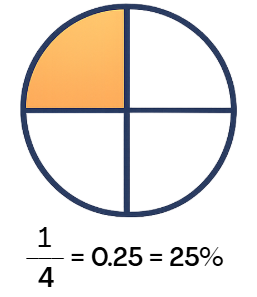
Students learn to recognise tenths and hundredths and to connect fractions, decimals, and percentages. For example, they may be asked to understand that one half is the same as 0.5 or 50%, and to move between these representations depending on the question.
Decimals are also used in practical contexts, particularly in measurement. Children may need to compare decimal values, place them correctly on a number line, or use them when converting between units. This requires strong place value understanding, and confusion is common when students treat decimals like whole numbers.
Percentages are introduced in a simple, intuitive way, often using familiar contexts such as parts of a group or portions of a whole. However, students are expected to reason about size and proportion, not just memorise equivalences.
Many Year 4 students struggle here because decimals and percentages look unfamiliar, even when the underlying ideas are connected to fractions they already know. Without clear visual grounding, these topics can feel abstract and intimidating.
Data & Graphs (Two-Way Tables and Scaled Graphs)
In Year 4, data handling becomes more demanding and more analytical. Students are no longer just reading simple graphs; they are expected to organise, interpret, and compare data in more structured ways.
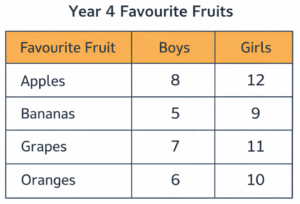
Children work with two-way tables, where information is grouped by two variables at the same time. This requires careful reading and an ability to track categories accurately. Many students struggle here because a small misreading can affect the entire answer.
Picture graphs and bar graphs also become more complex. Instead of each symbol representing one item, each symbol may represent 5, 10, or another quantity. Students must correctly interpret the key before answering questions, which adds a layer of reasoning beyond counting.
Questions often ask students to compare totals, find differences, or draw conclusions from the data. Errors at this stage are frequently caused by rushing, overlooking labels, or misunderstanding what the scale represents rather than poor calculation skills.
Data interpretation in Year 4 plays an important role in developing logical thinking and problem-solving skills that are used across many areas of maths in later years.
Measurement (Conversions, Area, and Perimeter)
In Year 4, measurement becomes more precise and more demanding. Students are expected not only to measure accurately, but also to convert between units and apply measurement skills in problem-solving contexts.
Children work with length, mass, capacity, time, perimeter and area. Conversions such as centimetres to metres, grams to kilograms, and millilitres to litres require a solid understanding of place value and number relationships.
Time is another area where expectations increase. Students read and interpret timetables, calculate elapsed time, and work with minutes and seconds. Many errors here come from tracking steps incorrectly rather than from weak arithmetic.
Area and perimeter are introduced more formally. Students learn to calculate perimeter by adding side lengths and to find area by counting square units. Confusion often arises when children mix up these two ideas or apply the wrong method to a problem.
Measurement difficulties in Year 4 are usually conceptual rather than mechanical. A child may know how to calculate but struggle to decide which unit, conversion, or method a question requires.
Geometry (Angles, Symmetry, and Nets)
Geometry in Year 4 becomes more structured and more precise. Students move beyond simply recognising shapes and are expected to describe, classify, and analyse geometric features.

A key new focus is angles. Children learn to identify right angles and compare angles as smaller than, equal to, or larger than a right angle. This requires careful visual judgement and an understanding that angles are about turn, not side length.
Students also work with symmetry, identifying lines of symmetry in shapes and completing symmetrical figures. This demands accuracy and spatial awareness, especially when shapes are irregular.
Students are also introduced to tessellations, where shapes are repeated to cover a surface without gaps or overlaps. This topic draws heavily on spatial reasoning and pattern recognition. Many students find tessellations challenging because they require visualising how shapes fit together through sliding, turning, or flipping, rather than following a fixed procedure.
Another important addition is nets of 3D shapes. Students learn how flat shapes can fold to form solid objects such as cubes or rectangular prisms. Many children find this challenging because it requires visualising movement and structure at the same time.
Geometry difficulties in Year 4 are often linked to spatial reasoning rather than calculation. When these ideas are not well understood, students may struggle later with transformations, coordinate geometry, and more advanced shape properties.
Chance (Outcomes and Reasoning)
In Year 4, chance moves beyond simple language and becomes more structured. Students are expected to list possible outcomes and reason about which outcomes are more or less likely.
Children work with everyday experiments such as tossing coins or rolling dice. They may be asked to identify all possible outcomes, compare likelihoods, or decide which results are most common. This requires organised thinking rather than guesswork.
A common challenge is keeping track of outcomes systematically. Some students miss possibilities or repeat the same outcome in different forms. Others rely on intuition instead of logical reasoning, which can lead to incorrect conclusions.
Although formal probability calculations are not introduced yet, Year 4 lays the groundwork for them. Students who learn to think carefully about outcomes and likelihoods at this stage are better prepared for probability concepts in later years.
Where Year 4 Students Commonly Struggle
Year 4 is often where maths begins to feel noticeably harder for many students. The difficulty usually comes not from individual topics, but from the increased expectation to combine skills and explain reasoning clearly.
A common struggle is managing multi-step problems. Students may understand each step in isolation but lose accuracy when several steps are required in sequence. This is especially evident in word problems involving addition, subtraction, or measurement conversions.
Decimals, percentages, and scaled data introduce unfamiliar representations that can feel abstract. Children who are comfortable with whole numbers may apply the same thinking to decimals, leading to errors in place value and comparison.
Geometry also presents challenges, particularly with angles, symmetry, tessellations, and nets. These topics rely heavily on spatial reasoning, which develops at different rates in different children.
Finally, many Year 4 students struggle to communicate their thinking. Even when an answer is correct, explaining how it was reached can feel difficult. When this skill is weak, confidence often drops, and small gaps can begin to affect multiple areas of maths.
How Parents Can Support at Home
In Year 4, supporting maths learning at home is less about practising more questions and more about strengthening understanding and reasoning.
Encouraging children to explain their thinking out loud remains one of the most effective strategies. Asking questions such as “Why did you choose that method?” or “How do you know this makes sense?” helps children organise their ideas and become more confident problem-solvers.
Everyday situations can still be powerful learning opportunities. Estimating totals while shopping, discussing time schedules, or comparing measurements during cooking all reinforce Year 4 concepts naturally and without pressure.
It is also helpful to slow things down when new ideas such as decimals, percentages, or unit conversions are introduced. Rushing for speed often leads to shallow understanding. Accuracy, clarity, and confidence matter far more at this stage than quick answers.
When mistakes happen, treating them as chances to reflect rather than failures helps children stay engaged. Calm discussion and gentle correction are far more effective than repeated drilling when difficulties are conceptual rather than procedural.
When Extra Support May Be Needed
Some adjustment in Year 4 is normal as expectations increase. However, ongoing difficulty can be a sign that a child needs additional support to keep pace with the curriculum.
Parents may notice that homework regularly becomes stressful, that their child avoids maths tasks, or that mistakes increase even in topics that were previously manageable. Difficulty with word problems, decimals, or explaining reasoning clearly are common warning signs at this stage.
Inconsistency is another indicator. A child may perform well on familiar questions but struggle when problems are presented in a slightly different format. This often points to gaps in understanding rather than a lack of effort.
Addressing these issues early helps prevent frustration and loss of confidence in later years. Support in Year 4 is most effective when it focuses on strengthening foundations and reasoning, allowing children to approach more advanced topics with greater clarity and confidence.
Next Steps for Parents
Year 4 marks an important shift in a child’s maths journey. The topics introduced at this stage build directly on earlier foundations while preparing students for more abstract thinking in the years ahead.
Understanding what Year 4 maths really involves allows parents to recognise when a child is coping well and when extra support may be helpful. Small gaps that are addressed early are far easier to manage than those that are left to grow over time.
With the right guidance, clear explanations, and steady encouragement, Year 4 can become a year where students strengthen their confidence and develop more effective problem-solving habits.
Related Links