What Your Child Is Expected to Know in Year 6 Maths (Australia)
Introduction
Year 6 is a pivotal year in mathematics. It brings together everything students have learned in earlier years and expects them to apply these skills with greater independence, accuracy, and reasoning.
At this stage, maths is no longer about learning isolated procedures. Students are expected to interpret information carefully, choose efficient strategies, and justify their thinking clearly. Problems are often multi-step, less structured, and presented in unfamiliar contexts.
Year 6 also marks a transition toward secondary-school-style thinking. Topics such as fractions, percentages, algebraic reasoning, data interpretation, and measurement are used together rather than taught separately. Small gaps that were manageable in earlier years can become more visible when ideas are combined.
Understanding what Year 6 maths really involves helps parents recognise whether their child is ready for the increased demands ahead or whether targeted support may be helpful before moving into high school.
Number (Integers, Operations, and Reasoning)
In Year 6, number work becomes broader and more conceptual. Students are expected to work confidently with positive and negative numbers, understand their position on a number line, and use them meaningfully in problem-solving contexts.
Operations with whole numbers are now assumed knowledge. Instead of practising methods in isolation, students apply them within complex, multi-step problems that may involve estimation, checking for reasonableness, or choosing the most efficient strategy. Mental calculation and flexibility play a larger role than in earlier years.
Fractions, decimals, and percentages are used interchangeably and often within the same question. Students are expected to convert between these forms fluently and to recognise equivalence without being prompted. Errors at this stage often come from weak conceptual understanding rather than from calculation mistakes.
Negative numbers can be particularly challenging. Students must reason about direction, change, and relative size rather than rely on concrete models. This is often one of the first times maths feels abstract for many learners.
By Year 6, success in number work depends heavily on reasoning, clarity, and confidence, not just speed or memorisation.
Algebra & Patterns (Rules, Relationships, and Generalisation)
In Year 6, algebraic thinking becomes more explicit and more demanding. Students are expected to recognise patterns, describe rules accurately, and apply these rules to new situations rather than relying on trial and error.
Children work with number sequences, function-style rules, and missing values, often within tables or word problems. They may be asked to explain how a pattern grows, predict later terms, or determine an unknown value based on a given relationship.
A key shift at this stage is the move toward generalisation. Students are expected to think about how a rule works for all cases, not just for the numbers shown. This prepares them for formal algebra in secondary school, even though letters and equations are still used cautiously and in context.
Many students find this challenging because it requires clear logical thinking and precise language. Being able to continue a pattern is no longer enough; students must explain the relationship in a way that applies consistently.
Algebra in Year 6 is less about symbols and more about structure and reasoning. Students who develop confidence here tend to adapt more smoothly to algebraic equations in later years.
Fractions, Decimals, and Percentages (Advanced Use and Reasoning)
In Year 6, fractions, decimals, and percentages are treated as fully connected representations and are used extensively in problem-solving contexts. Students are expected to move between these forms confidently and to justify their choices clearly.
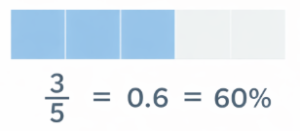
Fractions are no longer limited to simple equivalence. Students operate with fractions, compare values with different denominators, and interpret fractional quantities in real-world situations. Understanding why methods work is far more important than following steps mechanically.
Decimals are used with greater precision. Students compare, round, and operate with decimals across multiple place values and apply them in contexts such as measurement, money, and data. Errors often occur when students apply whole-number thinking to decimal values.
Percentages are used flexibly and meaningfully. Students calculate percentages of quantities, compare percentage changes, and recognise equivalence between fractions, decimals, and percentages without prompts.
At this stage, many questions deliberately mix representations. Success depends on conceptual clarity rather than memorisation. Students who struggle often know individual procedures but lack confidence when switching between forms.
Data & Statistics (Mean, Graphs, and Interpretation)
In Year 6, working with data becomes more analytical and more precise. Students are expected not only to read information from graphs, but to interpret data, compare values, and justify conclusions.
A key new concept at this stage is the mean (average). Students learn to calculate the mean and to understand what it represents in context. Many students find this challenging because it requires both calculation and interpretation. Confusion often arises when students mix up mean with other measures such as the most common value or the middle value.
Students also work with a wider range of graphs, including column graphs, line graphs, and pie charts. They must interpret scales accurately, compare categories, and explain trends or patterns shown in the data.
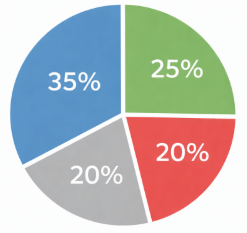
Questions increasingly combine data with real-world contexts. Students may be asked to decide whether a statement is supported by the data or to explain what the data suggests rather than simply report a number.
Difficulties in Year 6 data work are usually caused by rushed reading or weak reasoning rather than poor arithmetic. Careful attention to labels, scales, and context is essential at this stage.
Measurement (Speed, Area, Volume, and Time)
Measurement in Year 6 requires students to work with multiple concepts at once and to apply them in practical, real-world contexts. Accuracy, unit selection, and interpretation all matter more than in earlier years.
Students calculate perimeter, area, and volume using appropriate formulas and are expected to choose the correct measurement for a given situation. Problems often involve comparing measurements, converting between units, or interpreting results rather than performing a single calculation.
A significant step up in Year 6 is working with speed. Students reason about the relationship between distance, time, and speed and apply this understanding to solve problems involving travel or motion. These questions often require careful reading and multi-step thinking.
Time work also becomes more complex. Students interpret timetables, timelines, and elapsed time, sometimes across long periods or multiple events. Errors commonly occur when students lose track of units or overlook changes across days or hours.
Many Year 6 measurement mistakes stem not from weak calculation skills but from misinterpreting the context or selecting the wrong units. Clear reasoning and methodical problem-solving are essential at this stage.
Geometry (Angles, Nets, and Spatial Reasoning)
Geometry in Year 6 places strong emphasis on visualisation, precision, and spatial reasoning. Students are expected to analyse shapes carefully and to explain how their properties remain consistent across different representations.
Angle work becomes more formal. Students identify, compare, and reason about angles within shapes and real-world contexts. Accuracy matters, and students are expected to justify their conclusions rather than rely on estimation.
A major focus at this stage is understanding nets of 3D shapes. Students visualise how flat shapes fold into solids and how faces, edges, and vertices connect. This requires mentally rotating shapes and anticipating how parts relate when assembled.

Maps and direction may also appear, requiring students to interpret scale, orientation, and movement. These tasks combine geometry with measurement and demand careful attention to detail.
Geometry in Year 6 often reveals differences in spatial confidence. Some students can picture transformations easily, while others struggle to connect 2D representations with 3D objects.
Chance (Probability and Reasoned Judgement)
In Year 6, chance is treated less as guesswork and more as logical reasoning based on outcomes. Students are expected to describe probability using precise language and to justify their conclusions clearly.
Children list all possible outcomes for experiments such as rolling dice, drawing objects from a set, or spinning spinners. They compare likelihoods using terms such as impossible, unlikely, equally likely, likely, and certain, and explain why a particular outcome fits a category.
A key expectation at this stage is completeness and organisation. Students must ensure that all outcomes are accounted for without repetition. Many errors occur when outcomes are missed or when students rely on intuition instead of systematic listing.
Probability questions in Year 6 often include reasoning prompts. Students may be asked to decide whether a statement about chance is reasonable and to support their answer using evidence from the situation described.
This strand develops disciplined thinking and prepares students for more formal probability concepts introduced in secondary school.
Where Year 6 Students Commonly Struggle
Year 6 often exposes gaps that were less noticeable in earlier years. This is because students are expected to apply multiple ideas together, explain their reasoning clearly, and work with less guidance.
A common difficulty is managing complex, multi-step problems. Students may understand individual concepts such as fractions, percentages, or operations, but struggle when these are combined in unfamiliar contexts. Planning a solution becomes just as important as carrying it out.
Negative numbers and abstract reasoning can also be challenging. These ideas require students to think beyond concrete models, which can feel uncomfortable for learners who rely heavily on visual or procedural cues.
Algebraic reasoning is another area where students often struggle. Even without formal equations, the expectation to generalise patterns and explain relationships precisely can be demanding. Many students can spot a pattern but find it difficult to express the rule clearly and consistently.
Data interpretation, especially involving mean or pie charts, can be confusing when students focus on calculations without considering what the data actually represents. Misreading scales or percentages is common.
Finally, many Year 6 students struggle to communicate their thinking under time pressure. Even when their understanding is sound, weak explanation skills can affect performance and confidence as they prepare for secondary school.
How Parents Can Support at Home
In Year 6, support at home is most effective when it focuses on clarity of thinking and independence, rather than increased practice alone.
Encouraging children to explain their reasoning is particularly important. Asking questions such as “How do you know this works?” or “Is there another way to approach this?” helps strengthen logical thinking and prepares students for the expectations of high school maths.
Real-world applications remain valuable. Discussing data in news articles, interpreting timetables or schedules, estimating time and distance, or comparing percentages in everyday situations all reinforce Year 6 concepts naturally.
It is also helpful to slow down when children are working on complex, multi-step problems. Rushing often leads to careless errors or incomplete reasoning. Careful planning and checking should be encouraged over speed.
Maintaining a positive attitude toward mistakes is essential at this stage. Year 6 maths is challenging, and errors are often a sign that students are stretching their thinking rather than failing. Supportive discussion helps build confidence and resilience.
When Extra Support May Be Needed
Some difficulty in Year 6 is expected, as the work is more demanding and closely resembles secondary-school mathematics. However, ongoing struggles can indicate that a child may benefit from additional support before moving into high school.
Parents may notice persistent confusion with multi-step problems, difficulty explaining reasoning, or increasing frustration with maths tasks. Problems involving fractions, percentages, data interpretation, or time are common pressure points at this stage.
Inconsistency is another important sign. A student may perform well on straightforward questions but struggle when concepts are combined or presented in unfamiliar formats. This often points to gaps in understanding rather than a lack of effort.
Addressing these issues in Year 6 is particularly important. Strengthening reasoning skills and confidence now can make the transition to secondary school significantly smoother and reduce stress later on.
Next Steps for Parents
Year 6 is the final year of primary mathematics and plays a crucial role in preparing students for the expectations of secondary school. The emphasis on reasoning, interpretation, and independent problem-solving reflects the skills students will need in the years ahead.
Understanding what your child is expected to know at this stage helps you identify strengths, recognise emerging gaps, and decide whether targeted support may be helpful. Early clarity can prevent small misunderstandings from becoming larger obstacles later.
With steady encouragement, clear explanations, and the right level of support, Year 6 can become a confident stepping stone into secondary mathematics rather than a source of anxiety.
Related Links