What Parents Should Know About Grade 7 Math (Common Core)
Introduction
Seventh-grade math represents a major step toward algebraic thinking. While earlier grades focus on building numerical fluency, Grade 7 emphasizes relationships between quantities, logical reasoning, and the use of variables to describe mathematical situations.
One of the most important ideas introduced this year is proportional relationships. Students learn to analyze how two quantities change together, whether in ratios, unit rates, percentages, or scale drawings. These ideas appear frequently in real-world situations such as pricing, maps, recipes, and speed comparisons.
Students also expand their understanding of rational numbers, including negative numbers. They learn to perform all four operations with positive and negative fractions and decimals, strengthening their ability to reason about numbers on a number line.
Another major development is the use of algebraic expressions and equations to represent relationships. Students write expressions, solve equations and inequalities, and interpret mathematical statements involving variables.
Geometry and data analysis continue to grow as well. Students investigate scale drawings, calculate areas of complex figures, explore circles, and analyze probability and statistical data.
Together, these topics build the foundation for the more formal algebra and geometry that follow in eighth grade and high school.
Proportional Relationships (Ratios, Rates, Percent, and Scale Drawings)
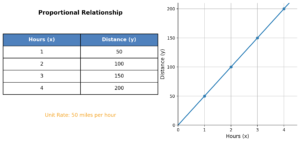
One of the central themes of Grade 7 math is understanding proportional relationships. Students learn how two quantities can change together at a constant rate and how this relationship can be represented in tables, graphs, equations, and real-world situations.
Ratios and unit rates continue to play an important role. Students compare quantities such as price per item, miles per hour, or ingredients in a recipe. By focusing on the unit rate, they learn how to determine how one quantity changes when another increases or decreases.
Percent problems become more sophisticated as well. Instead of simply calculating percentages, students solve real-world situations involving discounts, tax, tips, and percent increase or decrease. For example, they might calculate the sale price of an item after a 25% discount or determine how much a price increased compared with the original cost. These problems reinforce the idea that percentages represent proportional relationships.
Another key concept introduced in Grade 7 is proportional reasoning through equations and graphs. Students learn that a proportional relationship can be written as an equation of the form y = kx, where k represents the constant of proportionality. On a coordinate graph, these relationships appear as straight lines that pass through the origin. This idea begins to connect arithmetic thinking with algebraic representation.
Scale drawings provide an important geometric application of proportional reasoning. Students interpret maps, blueprints, and diagrams where lengths are reduced or enlarged by a consistent scale factor. By working with scale drawings, they learn how proportional relationships apply to real measurements and spatial reasoning.
Through these experiences, students develop a deeper understanding of how quantities relate to one another. This skill becomes essential for algebra, science, and many real-world problem-solving situations.
Rational Numbers and Operations (Working with Positive and Negative Numbers)
Another important development in Grade 7 is the extension of number operations to rational numbers, which include positive and negative fractions, decimals, and integers. While students were introduced to negative numbers in earlier grades, Grade 7 focuses on performing all four operations with them confidently.
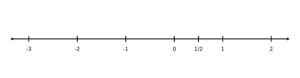
Students begin by strengthening their understanding of the number line. They learn that numbers extend infinitely in both directions, with positive numbers to the right of zero and negative numbers to the left. This visual model helps students reason about comparisons, distances between numbers, and the effects of different operations.
Addition and subtraction with negative numbers are often introduced through real-world contexts such as temperature changes, financial gains and losses, or elevations above and below sea level. By interpreting these situations carefully, students learn why rules like “subtracting a negative is the same as adding” make sense rather than memorizing them mechanically.
Multiplication and division with positive and negative numbers follow logical patterns as well. Students observe that multiplying numbers with the same sign produces a positive result, while multiplying numbers with different signs produces a negative result. Understanding these patterns helps students apply the rules consistently.
Operations also extend to fractions and decimals, including negative values. Students add, subtract, multiply, and divide rational numbers in different forms while paying close attention to signs and place value.
These skills are essential for later algebraic work. When students become comfortable operating with rational numbers, they are better prepared to solve equations, analyze graphs, and reason about quantities that increase and decrease.
Expressions, Equations, and Inequalities (Building Early Algebra Skills)
In Grade 7, students move further into algebra by learning how to represent and solve mathematical relationships using expressions, equations, and inequalities. While earlier grades introduce simple variables, this year, students begin using algebra as a practical tool for solving problems.
Students start by writing and interpreting algebraic expressions. A variable represents an unknown quantity, and expressions combine variables with numbers and operations. For example, an expression such as 3x + 5 can represent three times a number plus five. Students learn how to evaluate these expressions for given values and how to interpret what they represent in real situations.
Solving one-step and two-step equations becomes a major focus. Students learn that solving an equation means finding the value of the variable that makes both sides equal. They use inverse operations to isolate the variable step by step. For example, if an equation involves adding or multiplying, students reverse those operations to find the solution.
Equations in Grade 7 often arise from word problems. Students translate real-world situations into algebraic equations and then solve them. This skill helps students see algebra not as a collection of rules, but as a method for describing and analyzing relationships.
Students also begin working with inequalities, which describe situations where values can be greater than or less than a certain number. Instead of a single solution, inequalities often represent a range of possible values. These solutions are commonly represented on a number line.
Throughout this section, reasoning and explanation remain important. Students are expected not only to solve equations but also to justify their steps and check that their solutions make sense in the original context.
These early algebra skills form the foundation for the more advanced equation solving and function work that appear in eighth grade and high school algebra.
Geometry and Statistics (Scale Drawings, Area, and Probability)
Geometry in Grade 7 continues to build on ideas from earlier grades, but students now apply those ideas to more complex figures and real-world situations. A major focus is understanding scale drawings, where lengths in a diagram represent larger or smaller real measurements using a constant scale factor. Students interpret maps, diagrams, and blueprints, using proportional reasoning to determine actual distances or dimensions.
Area concepts also expand. Students learn how to calculate the areas of figures such as triangles, parallelograms, trapezoids, and composite shapes. Many of these formulas are developed by rearranging or decomposing shapes into rectangles and triangles. By analyzing how shapes can be broken apart and recombined, students strengthen both their geometric understanding and their reasoning skills.
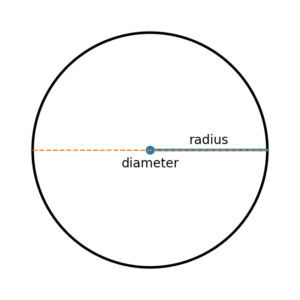
Circles are introduced more formally as well. Students investigate the relationships between a circle’s radius, diameter, circumference, and area. They learn how these measurements relate to each other and apply formulas to solve practical problems involving circular shapes.
Another important part of this unit is probability and statistics. Students learn how to analyze random events and describe the likelihood of different outcomes. They calculate simple probabilities and explore situations where multiple outcomes are possible.
Students also work with data displays such as dot plots, histograms, and box plots. By examining how data is distributed, they learn how to interpret patterns, compare groups, and draw reasonable conclusions.
Together, these geometry and data topics help students connect mathematical ideas to the physical world and develop stronger analytical thinking.
Problem Solving and Mathematical Thinking (How Common Core Ties Everything Together)
Throughout Grade 7, students are expected to apply multiple ideas together rather than treating each topic as a separate skill. Problems often combine proportional reasoning, algebraic thinking, geometry, and numerical operations within the same situation.
Students learn to begin by carefully analyzing a problem, identifying what information is given and what must be found. They choose appropriate strategies such as writing equations, using proportional reasoning, drawing diagrams, or organizing information in tables. This approach encourages students to think logically rather than relying on memorized procedures.
Word problems become more complex as well. A single problem may require several steps, combining operations with rational numbers, algebraic expressions, or geometric reasoning. Students must interpret the situation, decide which mathematical tools apply, and justify their reasoning clearly.
Visual models also remain important. Graphs, number lines, diagrams, and tables help students represent relationships between quantities. These representations make abstract ideas easier to understand and allow students to check whether their solutions make sense.
Explanation plays a central role in Common Core mathematics. Students are expected to describe how they arrived at an answer and explain why their method works. This emphasis on reasoning helps build deeper understanding and strengthens communication skills.
By regularly connecting concepts from different parts of the curriculum, Grade 7 math encourages flexible thinking. Students begin to see mathematics as a coherent system of ideas rather than a collection of isolated rules. This mindset prepares them for the more advanced algebraic reasoning introduced in eighth grade.
Conclusion: How Parents Can Support Grade 7 Math Success
Grade 7 is an important transition year in mathematics. Students begin using algebraic reasoning more regularly while continuing to apply arithmetic skills in new and more complex situations. Success during this year often depends on whether students understand the ideas behind the procedures they use.
Parents can help by encouraging students to explain their thinking when solving problems. Asking questions such as “Why does that work?” or “How did you decide what to do first?” helps students strengthen their reasoning and deepen their understanding.
It is also helpful to connect math to everyday situations. Percent calculations appear when discussing discounts or tips, ratios appear in recipes and comparisons, and probability arises in games and real-life decisions. Seeing these connections helps students recognize that mathematics is not limited to the classroom.
Consistency with foundational skills is equally important. Comfort with fractions, decimals, and negative numbers allows students to focus more on reasoning and less on basic calculations. Regular practice with these skills can make new topics feel much more manageable.
Most importantly, students benefit from developing confidence and persistence. Some Grade 7 topics may feel challenging at first, especially when algebraic thinking is introduced. With encouragement and steady practice, students can learn to approach problems methodically and build strong mathematical habits that support future learning.
By the end of seventh grade, students who understand proportional relationships, rational numbers, equations, and geometric reasoning are well prepared for the deeper algebra and functions they will encounter in eighth grade and beyond.
Related Links