What Parents Should Know About Grade 8 Math (Common Core)
Introduction
Grade 8 math is where middle school mathematics starts to look much more like high school algebra and geometry. Students still work with numbers, equations, graphs, and shapes, but the focus shifts toward deeper structure, general rules, and abstract reasoning. This is often the year when families notice a clear jump in difficulty.
A major part of Grade 8 involves linear equations and functions. Students learn how algebraic rules connect to graphs and tables, and they begin recognizing patterns that can be described with equations. Instead of solving only isolated problems, they study relationships between quantities and represent those relationships in multiple ways.
Geometry also becomes more formal. Students investigate transformations such as reflections, rotations, and translations, and they use those ideas to reason about congruence and similarity. The Pythagorean Theorem becomes a major new tool, especially in coordinate geometry and real-world problem solving.
Another important development is the use of systems of equations, where two linear relationships are analyzed together. Students also work with exponents, scientific notation, and data patterns in more structured ways.
By the end of Grade 8, students are expected to think more independently, connect ideas across topics, and explain why mathematical relationships work. This makes Grade 8 an important bridge to Algebra 1 and higher-level math.
Linear Equations and Functions
In Grade 8, students deepen their understanding of linear relationships and connect algebraic equations directly to graphs. While earlier grades introduce patterns and proportional relationships, this year focuses on describing how two quantities change together in a more general way.
A linear equation represents a relationship where one quantity increases or decreases at a constant rate. Students learn to recognize this constant rate of change and understand how it appears in tables, graphs, and equations. Rather than treating these representations separately, they learn how each one describes the same relationship.
Linear relationships can be written in the form y = mx + b. In this equation, m represents the rate of change (slope), and b represents the starting value, known as the y-intercept. Students interpret these values in real situations. For example, a taxi fare might include a fixed starting charge plus a cost for every mile traveled. The starting charge corresponds to the y-intercept, while the cost per mile represents the slope.
Students also learn how to graph linear equations on a coordinate plane. They identify where the line crosses the vertical axis and use the slope to determine how the line rises or falls as x changes. By plotting points and connecting them, they see how the equation produces a straight line.
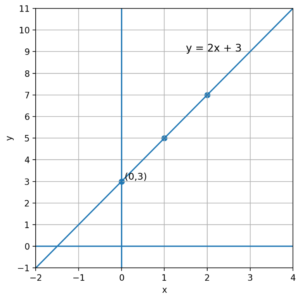
Another important skill involves deciding whether a relationship is linear. Students examine tables of values and determine whether the rate of change remains constant. When it does, the relationship can be represented by a linear equation.
These ideas prepare students for the formal study of functions in high school algebra. By connecting equations, graphs, and real-world situations, Grade 8 math helps students understand how algebra describes patterns and relationships.
Systems of Linear Equations
In Grade 8, students begin working with systems of linear equations, which involve two equations that describe two different relationships between the same variables. Instead of solving a single equation, students now analyze how two linear relationships interact with each other.
A solution to a system of equations is a point that satisfies both equations at the same time. When the equations are graphed on the same coordinate plane, the solution appears at the point where the two lines intersect. This graphical interpretation helps students understand why a system may have one solution, infinitely many solutions, or no solution at all.
Students learn several methods for solving systems. One common approach is graphing, where both equations are drawn on the same coordinate grid and the intersection point is identified visually. Another method involves substitution, where one equation is rewritten so that it can be inserted into the other. A third method, often called elimination, involves adding or subtracting the equations to remove one variable.
These techniques help students see that different methods can lead to the same result. Rather than memorizing procedures, students learn to choose the strategy that makes the most sense for a given problem.
Real-world applications play an important role in this topic. For example, students might compare two pricing plans, analyze when two moving objects meet, or determine when two quantities become equal. In each case, the intersection of the two relationships provides the answer.
By studying systems of equations, students move closer to the kind of algebraic thinking used in high school mathematics. They learn that equations can describe relationships between quantities and that multiple relationships can be analyzed together to solve complex problems.
Exponents and Scientific Notation
In Grade 8, students extend their understanding of exponents and begin working with scientific notation, a compact way to represent very large or very small numbers. These ideas allow students to handle quantities that would otherwise be difficult to write or compare.
Students first review and strengthen the rules of exponents. They learn how repeated multiplication leads to expressions with powers and how exponent rules simplify calculations. For example, multiplying powers with the same base adds the exponents, while dividing powers subtracts them. Understanding these patterns allows students to simplify expressions efficiently.
Another important idea involves powers of ten. Because our number system is based on tens, powers of ten provide a convenient way to represent large numbers. For example, 10³ represents one thousand, while 10⁶ represents one million. Students recognize how moving the decimal point relates to multiplying or dividing by powers of ten.
Scientific notation builds directly on this idea. Instead of writing very large numbers in full, students express them as a number between 1 and 10 multiplied by a power of ten. For instance, the number 4,500,000 can be written as 4.5 × 10⁶. This format makes it easier to compare large values and perform calculations.
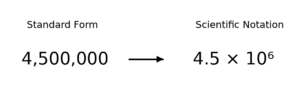
Students also learn how to convert numbers back and forth between standard form and scientific notation. They apply these skills in real-world contexts, such as describing distances in space, measuring microscopic quantities, or analyzing large data sets.
Operations with numbers written in scientific notation also become part of the curriculum. Students multiply and divide these expressions while keeping track of powers of ten and adjusting the decimal placement when necessary.
By mastering exponents and scientific notation, students gain tools that scientists, engineers, and mathematicians regularly use to describe quantities across a wide range of scales.
Geometry (Transformations, the Pythagorean Theorem, and Volume)
Geometry in Grade 8 becomes more analytical and connected to algebraic thinking. Students explore how shapes move, how distances relate to coordinates, and how geometric relationships can be expressed using equations.
One major topic involves transformations on the coordinate plane. Students study translations, reflections, and rotations, learning how these movements change the position of a shape without changing its size or shape. By performing sequences of transformations, they begin to understand why two figures are congruent. This approach emphasizes reasoning and structure rather than memorizing rules.
Students also investigate similarity and scaling. When figures are enlarged or reduced, the ratios between corresponding side lengths remain constant. This idea connects geometry to proportional reasoning learned in earlier grades.
A central concept introduced in Grade 8 is the Pythagorean Theorem, which describes the relationship between the sides of a right triangle. Students learn that the square of the longest side equals the sum of the squares of the other two sides. This theorem allows students to find unknown side lengths and solve geometric problems involving right triangles.
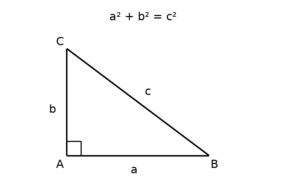
The theorem also plays an important role in coordinate geometry. By applying the relationship between the sides of a right triangle, students can determine the distance between two points on the coordinate plane. This connects geometric reasoning with algebraic formulas.
Another part of this unit focuses on volume. Students learn how to calculate the volume of three-dimensional shapes such as cylinders, cones, and spheres. Rather than memorizing formulas without context, they explore how these formulas relate to earlier ideas about area and scaling.
Through these topics, students begin to see geometry as a system of logical relationships. Transformations, right triangles, and volume formulas all rely on patterns and reasoning that extend beyond simple measurement.
Statistics and Data Analysis
In Grade 8, statistics becomes more focused on patterns, trends, and relationships between two variables. Instead of only describing one set of data, students now examine how two quantities may be connected and whether one helps predict the other.
A major idea in this unit is the scatter plot. Students graph pairs of data values on a coordinate plane and look for patterns in how the points are arranged. When the points cluster around an upward trend, students recognize a positive association. When they slope downward, they identify a negative association. If no clear pattern appears, they understand that there may be little or no association between the variables.
Students also learn to describe the strength and shape of a relationship. Some scatter plots show points tightly grouped around a trend, while others are much more spread out. This helps students think carefully about whether a relationship is strong enough to support a prediction.
Another important skill is drawing or interpreting a line of best fit. Students use this line to model the overall trend in the data and make reasonable estimates. For example, they might predict how many hours of study are associated with a certain test score, or how a person’s height might relate to arm span. They also learn that predictions are more reliable when they stay within the range of the given data.
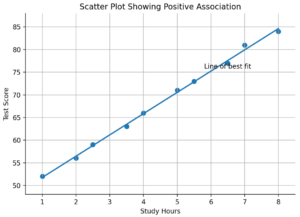
Through this work, students begin to see statistics as more than graph reading. They use data to identify relationships, support conclusions, and make informed predictions. These ideas prepare them for more advanced statistical reasoning in high school.
Problem Solving and Mathematical Thinking (How Common Core Ties Everything Together)
By eighth grade, mathematics increasingly focuses on reasoning, structure, and connections between ideas. Students no longer treat topics such as algebra, geometry, and statistics as separate skills. Instead, they learn to use these ideas together when solving complex problems.
Many problems now require several steps and careful planning. A student might begin by writing an equation, then represent the relationship on a graph, and finally interpret the result in a real-world context. This process encourages students to think about why a method works rather than simply following a procedure.
Students also practice analyzing mathematical relationships. For example, they may compare two linear equations to determine which situation grows faster or predict when two quantities will become equal. These tasks require interpretation, reasoning, and clear explanation.
Another important skill involves evaluating whether an answer makes sense. Students check solutions using estimation, substitution, or graphical reasoning. When a result seems unreasonable, they learn to revisit their steps and identify where the mistake occurred.
Mathematical communication also becomes more important. Students explain their reasoning using equations, graphs, and written arguments. This ability to justify a solution helps strengthen both logical thinking and conceptual understanding.
Through these experiences, eighth grade mathematics prepares students for the demands of high school. Instead of focusing only on calculation, students develop the ability to analyze relationships, represent ideas in multiple ways, and solve unfamiliar problems with confidence.
Conclusion: How Parents Can Support Grade 8 Math Success
Eighth grade marks an important turning point in a student’s mathematical journey. Many of the topics introduced this year – especially algebraic equations, functions, and the Pythagorean Theorem – form the foundation for high school mathematics. A solid understanding at this stage can make subjects like Algebra I, Geometry, and Algebra II far more manageable.
Parents can help by encouraging students to focus on understanding relationships, not just completing calculations. When students see how equations connect to graphs or how geometric ideas link to algebraic formulas, math becomes more meaningful and less mechanical.
Regular practice also plays a major role. Working through problems steadily helps students become comfortable with solving equations, interpreting graphs, and analyzing data. Short, consistent study sessions tend to be more effective than occasional long ones.
It can also be helpful to ask students to explain their reasoning. When they describe how they solved a problem or why a method works, they reinforce their own understanding and identify any gaps in their thinking.
Finally, confidence matters. Some topics in eighth grade can feel challenging at first, especially when students begin solving unfamiliar types of problems. With encouragement, patience, and steady practice, students can develop the skills they need to move successfully into high school math.
Related Links